

A tortilla should be one of the simplest things in the cart. Flour, water, fat, salt, done. Then you turn the package over, and the ingredient list runs halfway around the back, past words you would need a search engine to place.
Packaging has grown enthusiastic about “clean,” “simple,” and “natural.” Those words are a starting point, not an answer. So what makes a clean-label tortilla worth buying? This guide looks past the front of the package at ingredients, gums, preservatives, storage, and how a tortilla behaves in a hot pan.
Clean Label Food Explained: What Does the Term Really Mean?
Here's what the packaging leaves out: “clean label” has no strict legal definition. It is a shopper’s idea rather than a regulated category, pointing toward simplicity and transparency.
In practice, it describes products with recognizable ingredients, straightforward labeling, few artificial colors, and fewer components added mainly for shelf stability. A short list still will not tell you everything about quality. The better question is whether you understand what is in the product and why. That is clean-label food explained without the gloss, and our guide to what “clean ingredients” means in food covers the broader label picture.
What Makes a Clean Label Tortilla? Start With the Ingredient List

A clean-label tortilla prioritizes a straightforward ingredient list, recognizable components, transparent labeling, and fewer unnecessary additions. Reading one takes ten seconds once you know where to look.
Start With the Basics
Traditional flour tortilla components are short: flour, water, fat or oil, and salt. That is not a rule demanding exactly four ingredients. It is a baseline.
Ask What Each Extra Ingredient Does
Anything past the basics is there for a reason: longer shelf life, consistent softness, flexibility, manufacturing performance, texture, or appearance. The goal is not to flinch at unfamiliar words. It is to know what each one does.
So what makes a clean label tortilla has less to do with the number of ingredients than with whether each one has a clear purpose.
Tortillas Without Gums or Additives: What Changes?
Gums, emulsifiers, and dough conditioners are not villains. They do specific jobs: keeping tortillas flexible, maintaining texture, helping production run consistently, and preserving the product's character during longer storage.
Some shoppers simply prefer fewer of them, and that preference has consequences. Leave those ingredients out, and the formula and the technique carry more weight. Tortillas without gums or additives rely on the flour, fat, and process for functional support instead. You taste it in freshness, texture, and the way the tortilla cooks.
Tortillas With No Preservatives Come With a Different Storage Story
Preservatives extend shelf stability. Remove them and storage does not become irrelevant. It becomes the main event.
Four questions settle most of it. Does the package belong in the refrigerator? How long does it keep once opened? Can it be frozen? Are the thawing instructions clear? Refrigeration and freezing are tools, not drawbacks. Our Original Tortillas keep four weeks refrigerated, unopened; seven days after opening; and six-plus months frozen in the original packaging. Tortillas with no preservatives require a little more attention to storage, which is why clear refrigeration and freezing instructions matter.
What to Look for in a Quality Tortilla Brand
Five checks, all answerable while you stand in the aisle.
- Ingredient transparency. Can you see what the tortilla contains without having to hunt for it?
- A reason for each ingredient. Does the brand explain its flour and oil, or only decorate the bag?
- Honest storage instructions. If a product omits preservatives, does the company state clearly how to store it?
- Cooking performance. Does it fold, warm, puff, crisp, and hold a filling the way you need it to?
- Flavor and texture. A short list means little if nobody reaches for a second tortilla.
What to look for in a quality tortilla brand goes beyond counting ingredients. Transparency and eating quality have to arrive together.
Fewer Ingredients Should Still Deliver More at the Table

Simplicity is not a reason to accept a worse tortilla. The test happens on the plate: soft enough to fold without cracking, willing to take light browning, flexible under a full load, with flavor that works alongside whatever goes inside.
Ingredient quality, recipe development, and cooking method shape that result. Ingredient count alone predicts none of it. Convenience should still produce something you want again.
Four Ingredients, One Very Rise & Puff Approach

When we developed our Original Tortillas, we wanted a label anyone could read and a tortilla worth the pan. Four ingredients: unbleached wheat flour, water, pure avocado oil, and sea salt.
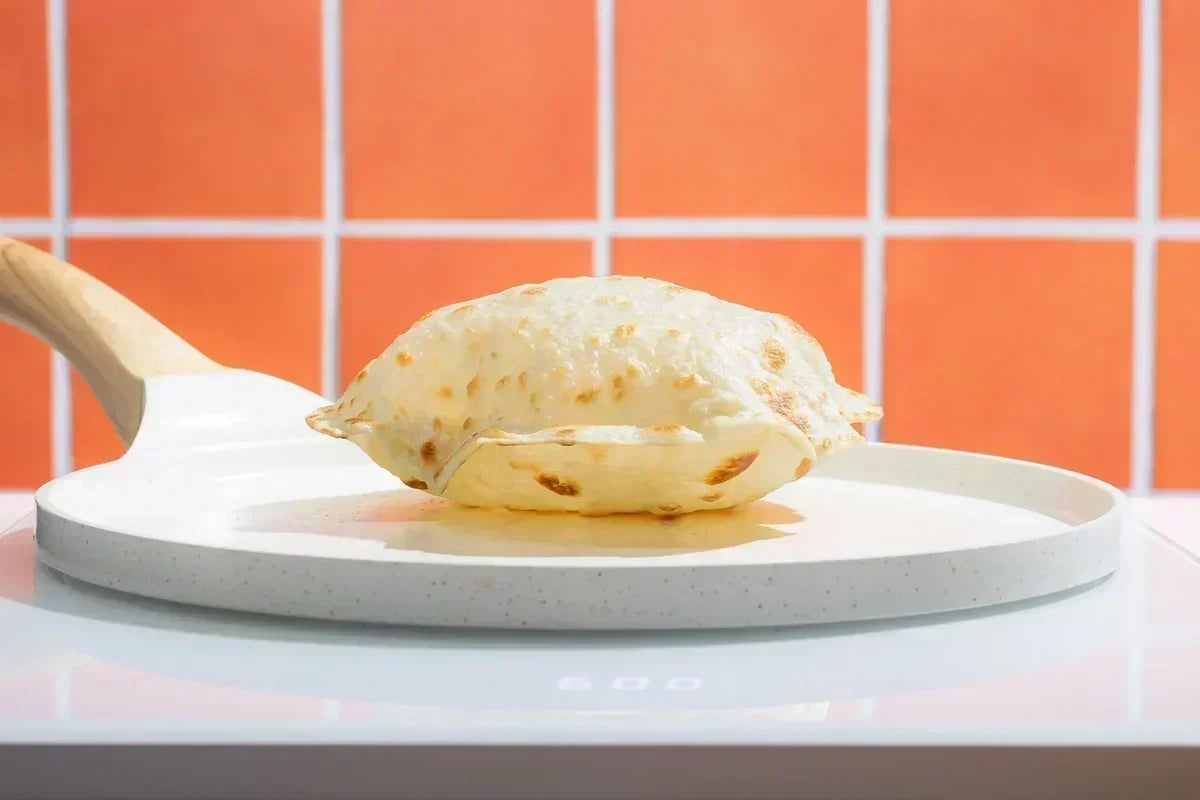
No preservatives, no artificial conditioners, no hydrogenated fats. They arrive par-cooked and live in the refrigerator or freezer, which is how we keep them fresh without adding anything to the formula. You finish them over medium heat for 20 to 30 seconds per side. In about sixty seconds, a flat disc becomes soft, flaky, and properly puffed. A short label that still earns its place at dinner.
Frequently Asked Questions
What makes a clean label tortilla different from a regular tortilla?
It emphasizes straightforward ingredients and transparent labeling, though the term is not a standardized legal category. Judge the ingredient list, storage instructions, taste, and texture yourself.
Does a short ingredient list always mean a better tortilla?
No. Ingredient count is one clue. Quality, purpose, flavor, texture, storage, and cooking performance matter as much.
Why do preservative-free tortillas need refrigeration?
Without preservatives built to extend room-temperature shelf life, cold storage is what maintains freshness.
Do clean-label tortillas still need to taste good?
Absolutely. Simpler labeling is never an excuse for a tortilla that cracks, tears, or disappoints in the pan.
Read the Label, Then Heat the Tortilla
Back to the aisle. You do not need a memorized list of ingredients to avoid. You need to know what is in the tortilla, why it is there, how it stays fresh, and whether it performs once warm. Once you know what makes a clean-label tortilla, the back of the package becomes much easier to read.
Start with four simple ingredients and see what happens when a Rise & Puff Original Tortilla hits a hot pan.


Leave a comment
All comments are moderated before being published.
This site is protected by hCaptcha and the hCaptcha Privacy Policy and Terms of Service apply.